
Darkwing Duck Gameplay
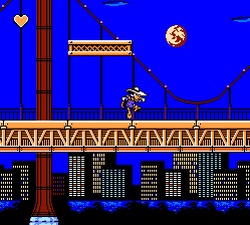
Darkwing Duck has that clicky platforming rhythm where your thumbs find the tempo on their own: step — breathe — jump — shoot — zip up on the hook. Grab a gamepad and suddenly the mask flutters in the headwind, the cape balloons, and you’re hunting that split second when the spotlight sweeps past so you can ghost across to the next ledge, hero-style. On NES, Darkwing Duck doesn’t meander: it’s all about forward momentum, clean timing, and feeling your arcs. Every button feeds the story of your run: a springy, forgiving jump, a snappy gas-gun shot, and the signature grappling hook that snaps onto round pegs overhead. The moment you realize Darkwing is wired to your thumbs and fits like a glove, the whole game just… clicks.
Jump, hook, and cape
The sweetest thing here is stitching jumps and hooks into one clean flow. Peek from cover, pop the cape to shrug off incoming fire, and in the same heartbeat reach up to tag a hanger with the hook. From there: to a ledge, to a sign, to a fire escape. Those seconds when the air itself seems to hold you up—that’s the old-school 8-bit magic, the exact feel so many remember as "Darkwing Duck on NES." The controls give you razor edge precision: a feather tap is a short hop; hold longer and you float a gap. Mistakes are on you, but the game is fair: it telegraphs with a lip of a ledge, a blinking trap, the telltale whir of gears. You learn to read the cues at speed.
The gas gun isn’t just "pew-pew"—it’s a toolbox for every encounter. Basic shots handle common goons, but the game opens up once you find special rounds. The electric charge roasts pesky fliers and knocks out snipers perched at awkward heights. Heavy gas lays down a chunky "brick" of trajectory, punching through tough foes or tagging bullies who won’t let you close. Arrow ammo practically draws an extra path: toss it, leave the target behind, and you’re already replanning the next platform. Ammo isn’t infinite, so every special is a little call to make: stash it for a boss, or spend it now to breathe through a hairy moment?
Level rhythm
The city missions feel like slices of superhero routine. At the S.H.U.S.H. computer (the HQ from the cartoon), you pick where to swoop in and who to put back in line: the docks, where waves lick the pilings and gusts threaten to blow you straight into the drink; the bridge, with spotlights sweeping its spans so tight you have to skate the edges of their cones; the rooftops, where transformers wheeze, sparks arc from rail to rail, and Megavolt has a rogue charge lurking around every corner. There are factory floors with conveyors and yawning gaps, amusement parks where every plush grin hides a spring, a catapult, or a spiked ball courtesy of Quackerjack. And the underground catacombs remind you the hook isn’t only for going up—it lets you ride out rockfalls and swing pivot to pivot while the mole thief Moliarty snickers somewhere in the dark.
No nagging timer here, but there’s a built-in metronome. Every hazard has a pattern. Electric arcs snap in pulses you start to feel in your bones. Platforms alternate in counterpoint, forcing a quiet "one-two" before you flick the hook. The water swells in sets, and the right jump comes not from the button, but from the moment that just feels right. You don’t just beat a stage—you perform it like a tune. Flub a note and you know where to tighten, where to push, and where to hold under the cape for a beat to let a string of bullets whisper past.
Boss duels
Boss fights play out like conversations between equals. The Liquidator puddles across the floor, crests into a wave, then snaps into a pillar—you find the range where you can fire safe before the surge reforms. Quackerjack hurls toys and cackles—but that laugh betrays the window when he’s open. Megavolt scatters angled bolts, turning the room into lightning geometry: jump to go over, shoot in the pocket, cape to parry the small stuff. It’s not about rote memorization—it’s about reading their rhythm. A couple of attempts and you just feel it: his window, your no-hit string. And when Steelbeak strolls onto the screen, you meet him as someone new—trained by these little musical puzzles where every bar is a choice and every volley lands on the beat.
The city’s vibe and little secrets
Darkwing Duck keeps you hooked with a tight, lived-in world. Wind whipping over the bridge, creaking chains at the shipyard, a goofy carnival run by the local maniac—it all adds up to St. Canard, where a duck superhero plays by his own rules. The game sprinkles delights: an extra life tucked behind a sneaky ledge; ammo where only a hook route is actually convenient; and around a corner where you expect trouble—a quiet window that lets you pull a slick shortcut. There are tons of those "aha" beats where you get the designers without a single word, and it’s charming as heck. You don’t just sprint—you notice. So you revisit cleared spots to nab that missing health pip or the ammo upgrade you spotted out of the corner of your eye the first time through.
The music keeps your heels tapping without ever smothering the action—classic chiptune locking in the pulse of jumps and shots. It works like a metronome, and you can’t help but sync up: pivoting on a ledge, zipping upward on the hook, pausing under the cape. At some point you stop thinking "Capcom platformer"—you’re just living in the hero’s skin, like watching an episode while writing the final beat yourself. So when someone brings up Darkwing Duck—or even says "Darkwing Duck on NES" outright—you instantly taste that blend: crisp controls, brisk speed, and boss duels that stick because you earn them with understanding, not luck.
And yeah, it asks for patience here and there—but only in the good way. It teaches you to catch the moment, is stingy with health, generous with rewards for bold play, and respectful of your time. You can bulldoze, sure, but it sings for players who wait that extra half-beat. Grappling hook, cape-as-shield, a gas gun with smart alt ammo—the kit is simple, but it blossoms into clean, crystalline mechanics where everything sits exactly where it should. That’s why Darkwing Duck is loved: it’s an honest adventure where you are the rhythm—and the conductor.